 Nederlands


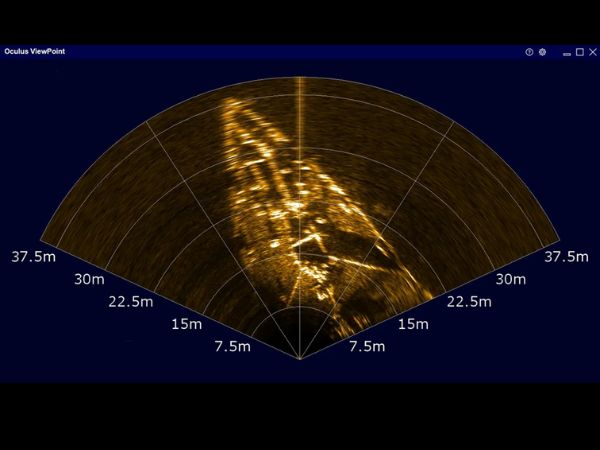
Sonar is becoming an essential tool in underwater drone and ROV operations. In environments where visibility is limited, it allows you to work accurately and reliably. Want to understand the different applications and how to choose the right system? Read our complete guide to underwater drones and ROVs.
Sonar (Sound Navigation and Ranging) uses sound waves to visualise objects and structures underwater. Unlike a camera, sonar does not rely on visibility and works independently of conditions such as turbidity, darkness or suspended particles. A multibeam imaging sonar, commonly used on underwater drones, emits hundreds of narrow sound pulses simultaneously. The reflections of these pulses are translated into a real time image.
This is not a photo. It is an interpretation of reflection:
- Strong reflections, such as metal or rock, appear bright
- Soft or absorbing materials remain dark
- Objects create an acoustic shadow
This combination is what makes sonar powerful. Instead of colour or contrast, you analyse structure, position and shape. This allows you to work with consistent data, regardless of visibility.
What do you see in sonar images?
For first time users, sonar images often look like noise or abstract patterns. This is normal. Sonar requires a different way of interpreting visual information.
A sonar image is structured differently:
- The point at the bottom represents your drone
- The outer edge shows the range
- Everything in between represents distance and angle
The key information comes from:
Reflection
Hard materials produce strong signals, such as ship hulls, pipelines or debris.
Shadow
Behind every object, a “dead zone” appears where no signal returns.
The longer the shadow, the larger or higher the object.
This is where sonar becomes truly valuable.
You are not just seeing objects, you are interpreting their shape and presence.
Choosing the right sonar
Together with our underwater drones, the Blueprint Subsea Oculus offers a powerful sonar solution. The M750d is designed for range and overview, while the M1200d focuses more on detail for precise inspection work.
The choice between the Oculus M750d and M1200d is not about better or worse, but about application.
The M750d is built for coverage and range. With a reach of up to approximately 120 meters, it is ideal for search operations, initial inspections and navigation in complex environments. It provides fast overview with less detail.
The M1200d has a shorter range of around 40 meters, but delivers significantly more detail. Where the M750d shows that something is present, the M1200d helps you understand what it is and its condition.
How to use sonar effectively
Sonar is not a plug and play tool. Its value depends on how you use it.
- Movement is essential.
A static sonar image provides limited information. By moving slowly or panning, perspective changes and structure becomes visible. - Work in phases.
Use lower frequency for scanning larger areas and switch to higher frequency for detailed inspection. - Use sonar as your primary source.
In low visibility, the camera becomes secondary. Sonar provides the main reference and confirmation. - Most importantly, learn to recognise noise.
Suspended particles, reflections from the seabed or thermal layers can distort the image. Experience comes from distinguishing signal from interference.
When does sonar justify the investment?
Sonar is an investment, but with the right application it delivers significant value. The benefit is rarely in one factor, but in the combination: faster localisation, reduced reliance on divers, fewer errors and more predictable workflows.
When is sonar not necessary?
There are also situations where sonar adds limited value. In clear water with good visibility, for simple visual inspections or non critical tasks, a camera is often sufficient. In those cases, sonar is useful as an addition, but not essential.
How sonar changes your workflow
The biggest impact of sonar is how you work. You move from searching to targeted operations. You are no longer dependent on conditions and can rely on consistent data. From uncertainty to control.
For many professionals, from inspection companies to researchers and recovery teams, this is exactly the difference that matters.
Is sonar the right step for your application?
If you work with underwater drones for inspection, monitoring, research or recovery, the same question eventually arises: Do you continue to rely on visibility, or do you want to operate under all conditions? Sonar is not necessary for everyone. But if your work takes place in environments where visibility is not guaranteed, it is often the logical next step.