 Nederlands


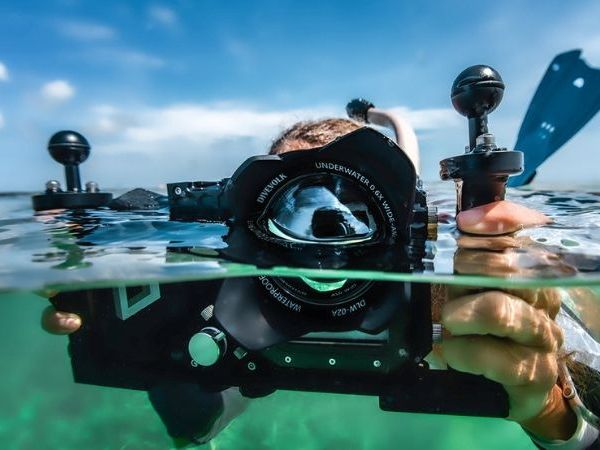
The Divevolk smartphone housing makes it possible to get serious about underwater photography with relatively simple means. Smartphones now have powerful cameras and software, but different optical laws apply underwater than above water. Light absorption, color loss, and limited stability play a major role. With targeted accessories, the smartphone underwater housing can be adapted to different diving conditions and photo and videography styles. Below are the seven most popular expansion options, with an explanation of what they add technically and when they really make a difference.
1. Underwater lights
Water absorbs light quickly and selectively. Red light disappears within the first few meters, followed by orange and yellow. As a result, images quickly look blue-green with little contrast. Underwater lights compensate for this by reintroducing full-spectrum light.
For photography and video, lights are especially important for:
- Depths from approximately 5 meters
- Subjects at close range, max. 1.5 meters
- Dark or limited visibility
With smartphones, an even light beam is extra important because the sensor is small and produces noise faster in low light. Lights with a wide beam provide smoother lighting and prevent harsh hotspots.
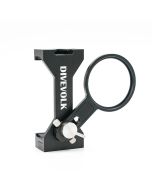
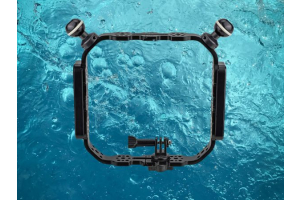
To use an underwater video light, extra accessories are required. The Divevolk aluminum clamp with 67mm lens adapter is required to attach a tray with an arm system to the SeaTouch 4 Max PLUS housing. Without this adapter, mounting lights is not possible. Subsequently, a Divevolk tray or the popular Weefine tray fits under the housing, onto which lights can be attached.
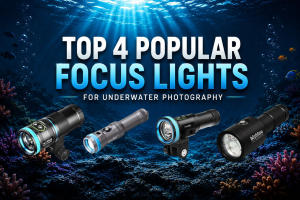
Top 3 light packages for the DIVEVOLK SeaTouch 4 Max PLUS
The DIVEVOLK SeaTouch 4 Max PLUS smartphone housing can be expanded with various video lights, depending on diving conditions and the type of shots you want to make. The following three light packages are often combined with this housing and differ mainly in light output, beam angle, and conditions.
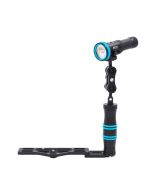
1. WeeFine Smart Focus 2600 underwater video light set
This set is aimed at a compact and lightweight configuration. With a maximum light output of approximately 2600 lumens, the lamp is suitable for short distances and close-up shots.
The package is mainly used in:
- Limited visibility or low ambient light
- Macro
Due to the lower light output and beam, this set is less suitable for clear, tropical blue water or wide-angle shots at a distance.
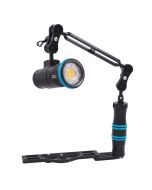
2. WeeFine Solar Flare 4500 underwater video light set
This lamp offers a higher light output and wider beam than the Smart Focus 2600. This makes it usable in a wider range of conditions.
Suitable applications include:
- Murky and dark water
- Clear tropical water
- General use for photo and video
- Wide angle and macro
The Solar Flare 4500 is a balanced choice for users who want to work with one lamp and seek flexibility between macro and wide-angle subjects.
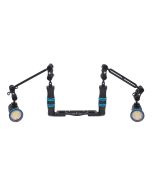
3. WeeFine Solar Flare 4500 duo underwater video lights set
This set consists of two Solar Flare 4500 lamps and offers more even lighting over a wider field of view. This reduces shadows, especially in wide-angle shots.
The duo setup is functional for:
- Wide-angle photography and video with even lighting
- Tropical blue water as well as murky and dark water
- Almost all conditions/situations
2. Red and green water filters
Filters work fundamentally differently than lights. Instead of adding light, they correct the color spectrum by reducing excess blue or green tones. This allows the camera to better determine white balance.
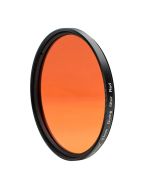
- Red filters are suitable for clear, blue water (tropical, good visibility), such as the Divevolk Sealens red filter for 67mm adapter.
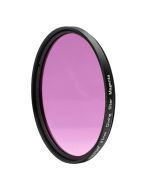
- Green water filters are suitable for green water with ambient light. Without ambient light, a green water filter is unnecessary, for example, the Divevolk Sealens magenta filter for 67mm adapter.
Filters are especially effective in natural light, in shallow water down to approximately 20 meters deep. To place a color correction filter on a Divevolk housing, the aluminum clamp with 67mm lens adapter is required. You clamp this firmly onto the housing, after which you can easily flip a filter in front of your lens and push it aside again if you get too shallow.
3. Divevolk conversion lenses: macro and wide angle
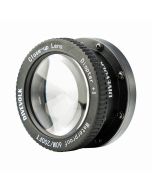
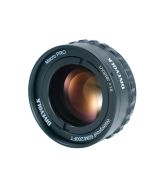
Macro lenses shorten the minimum focusing distance, making small subjects appear larger and sharper. This is especially relevant because smartphones themselves do not have true macro optics.
Commonly used macro lenses are:
- Divevolk +18 macro lens made of optical glass with coating
- Divevolk +8 macro lens for SeaTouch 4 Max PLUS
Wide-angle lenses help maintain the original field of view underwater and make it possible to stay closer to the subject. This is not only better for composition, but also for color and sharpness, because there is less water between the camera and the subject.
Commonly used wide-angle options are:
4. Tripod
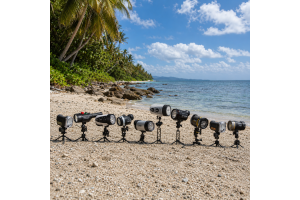
Stability is often more difficult underwater than above water. Even small movements are amplified by currents and buoyancy. A tripod can provide support here.
Applications where a tripod is useful:
- Video recordings with a fixed composition
- Timelapse or longer clips
- Macro shots where minimal movement is desired
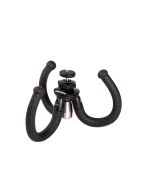
For smartphone users, this can help compensate for the limitations of digital stabilization. A commonly used option is the Divevolk flexible underwater tripod. We have also written a blog about all the benefits of using a tripod underwater.
5. Shutter trigger
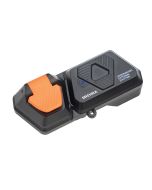
Operating a touchscreen often causes slight movement of the housing, which becomes visible as motion blur, especially in macro or low light. A shutter trigger or external shutter button makes it possible to take photos without touching the screen directly. You place the Divevolk external shutter button easily on top of the housing. You can then connect your phone to the external shutter button via Bluetooth. After that, you can take photos in a very easy, natural way by pressing that large shutter button on the top right of your housing. This is very easy to do, even with gloves on.
This increases control and consistency, especially with:
- Close-ups
- One-handed photography
- Use of gloves
6. Divevolk underwater touchscreen finger
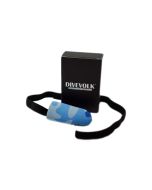
Although the Divevolk housing is fully touchscreen-compatible, operation underwater can be challenging with drysuit gloves. The Divevolk underwater touchscreen finger increases the contact surface and allows for more accurate selection, for example when:
- Manually setting focus
- Adjusting exposure compensation
- Operating camera apps
7. Tray and selfie stick
Both accessories mainly influence ergonomics and stability.
A tray provides:
- Better balance of the housing
- Less unwanted movement
- Possibility to position lamps correctly
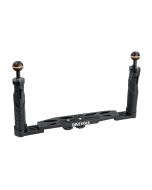
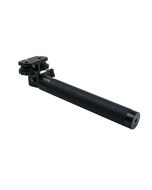
A commonly used tray is the Divevolk dual handle tray for SeaTouch. A selfie stick increases the range if you want to keep your t to keep your distance from coral or fish, for example. Of course, it is also great for taking fun selfies underwater! To place both the tray and the selfie stick, you must first place the aluminum clamp on the housing. At the bottom of this clamp is the screw thread onto which the tray or selfie stick can then be attached.
Summary
The Divevolk SeaTouch 4 Max PLUS is a modular system that grows with the user. With the right accessories, you can tailor the housing to diving conditions and the type of photo or videography. For almost all expansions, the Divevolk aluminum clamp with 67 mm lens adapter is required; only the touchscreen finger and shutter trigger are exceptions to this. That flexibility makes this system suitable for those who want to get started enthusiastically with underwater photography without immediately investing in a complete underwater camera set. You simply use your own smartphone underwater! We hear from many divers that they find it a nice and safe idea to take their smartphone with them in a Divevolk housing while diving, partly because in an emergency you can call directly with the smartphone still in the housing when you surface.